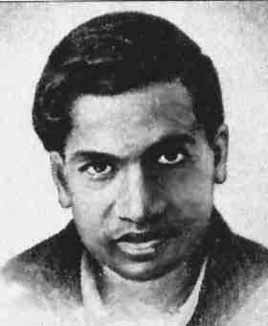
Ramanujan, one of the world’s greatest mathematician, once said: “An equation means nothing to me unless it expresses a thought of God.” His life is an inspiring read not only to his admirers like me but also to atheists who might find an alternate reason to his inventions.
I am struggling to remember that fortunate day, the day when my fascination towards the genius Srinivasa Ramanujan begun. I started reading everything about him, watched any film or documentary made to know more and more about the genius. Every time I was left astonished on how much a person can achieve in a life span of just 32 years.
I myself never had any major interest in the subject mathematics to blame Ramanujan’s mathematical discoveries to have charmed me. I am more fascinated by the fact that there was a man with no guidance or formal education on the subject but still did revolutionize the field to an extent that his works are still being proved by mathematicians up to lately 2012. He was a pure genius unlike others, a genius who invented himself and is still being discovered. His short life is a bane to the human race. The more you know about him, the more you connect to him and more surprised he leaves you with his brilliance.
Ramanujan, the typical Brahmin:
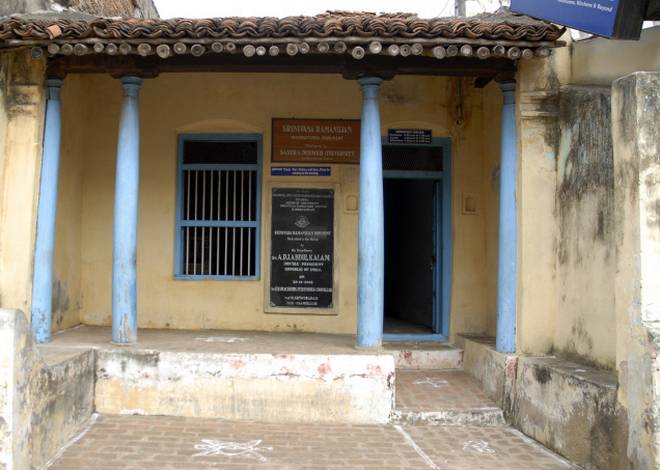
Srinivasa Ramanujan born on 22nd December 1887 was or rather will always be a mathematical genius. Born into an orthodox Tamil brahmin family in Erode, Tamil Nadu, Ramanujan’s father Kuppuswamy Srinivasa Iyengar, worked at a sari shop while his mother Komalatammal was a housewife. He had three younger siblings, but all died within a few months of birth. Ramanujan too always struggled with his health. He somehow recovered, probably only superficially.
Born in Brahmin family Ramanujan followed every Brahmin practice with great devotion. He learned all the religious rituals from his mother and followed a strict vegetarian diet. He was a great devotee of their family goddess Lakshmi in Namagiri and it is known fact how goddess of Namagiri influenced all his mathematical work.
Ramanujan’s Love for numbers:
Ramanujan, as a teenager, borrowed the book “A Synopsis of Elementary Results in Pure Mathematics” by G. S. Carr, which was then a book for entrance exams in universities. It is believed that this book changed his outlook towards the subject. He was then given a book on advanced trigonometry written by S. L. Loney. He by now had developed a deep love for the subject and even started working on his own theorems by the age of 13. He later was recognized with many awards and certificates by the age of 14 for his achievements in the subject.
Being a brilliant student Ramanujan also got a scholarship at Government Arts College in Kumbakonam. But he soon realized that none of the other subjects interested him anymore and he just passed in mathematics. He eventually lost his scholarship too. He then joined Pachaiyappas college, again only to pass in mathematics and failed in others. His extreme poverty too did not detach him from mathematics and he continued his work on it and left college without a degree.
Ramanujan’s mathematical Struggles:
In 1909 Ramanujan married Janaki, who was just 10 years old then. Well, girls marrying that young wasn’t uncommon then but they stayed with their parents until they reached puberty. Ramanujan was now looking for any job to support his family. He met V. Ramaswamy Iyer, founder of Indian Mathematical Society, wishing for a job at the revenue department. Ramaswamy Iyer was awestruck by looking at some of Ramanujan’s work and knew he cannot waste a talent like his with any trivial job. Ramanujan with help of Ramaswamy Iyer became a well-known person among the mathematicians there and was made a researcher at the University of Madras. Many of his work was even published in the Journal of Indian Mathematical Society. It is believed that Mr. Iyer Supported Ramanujan financial from his own pocket so that he could work on mathematics without a glitch.

In 1912, Ramanujan applied for a job at Madras port trust and got the job with few recommendations. Here too he finished all his work as early only to devote his remaining time to mathematics. His colleagues here presented some of his work to professor M. J. M. Hill at London, who looking at his papers understood the genius brain behind the work but also knew that without any formal education on the subject, the papers had many loopholes in them. Ramanujan was very naïve in his approach. But M. J. M. Hill gave him strong advice which helped Ramanujan to present some of his work to the Cambridge University.
Ramanujan and Hardy:
His papers showed how atypical at the same time outstanding his work was that they were in doubts of its originality and it got unnoticed initially by mathematicians at Cambridge. But as typically said only a diamond merchant can recognize the worth of that stone, which only needs to be cut and polished to unravel the true characteristics of it, similarly G. H. Hardy of Cambridge, was that merchant who discovered Ramanujan. Hardy was amazed by knowing that someone had such an eye for such great and complex mathematical inventions. He knew that such great work cannot be anyone imaginations but pure genius. Hardy sent Ramanujan’s papers to his fellow mathematician Littlewood who was not only astonished by Ramanujan’s work but also compared him to Jacobi ( But the great mathematician Jacobi came with a strong educational background unlike Ramanujan). We need to know here that G. H. Hardy and Littlewood were great mathematicians who ruled the mathematical world for years.
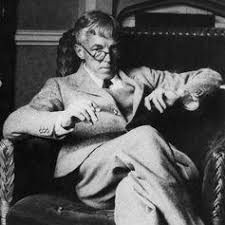
G H Hardy wanted Ramanujan to come to Cambridge. When one of his colleague E. H. Neville went to India for lecturing, he insisted him on convincing Ramanujan to come to Cambridge and continue his work there. Ramanujan declined the offer. In brahmin caste, it is believed that one who crosses the sea to travel a foreign land is considered impure and loses the sanctity of the caste. But eventually, Ramanujan did travel to England, only because of the goddess he believed in and his mother, gave him permission to do so.
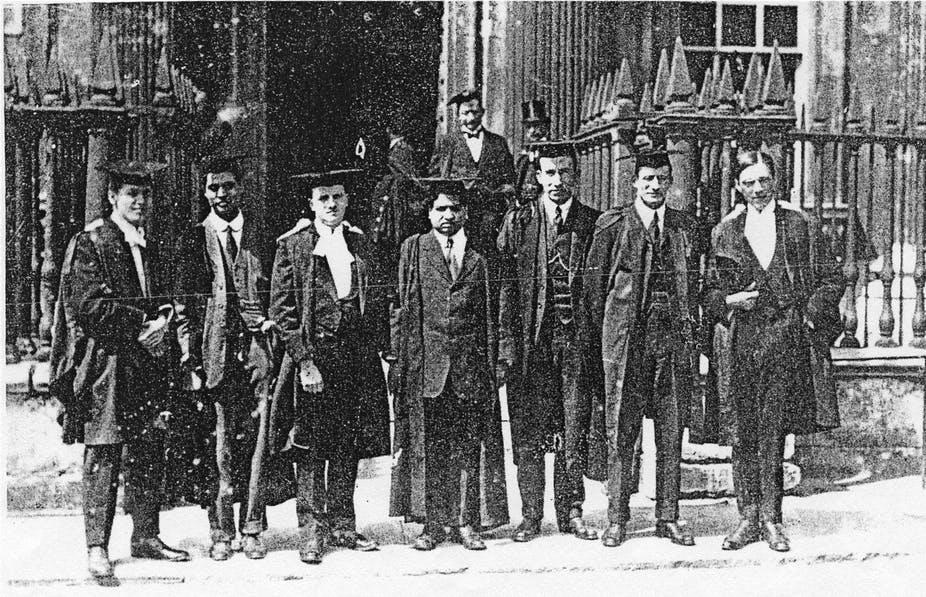
Ramanujan reached England on April 14, 1914. Seeing all of Ramanujan’s work in person, Hardy was proud of himself of discovering the treasure named Ramanujan. Ramanujan continued his work there along with Littlewood and Hardy and some of their works got published too. Within few days Hardy was astonished to realize that a man who had made such advance discoveries, one who could work on any complex theorems or any continued fraction did not know the basic functionality of a complex variable. This proved that Ramanujan was a self-taught mathematician, an original genius with no formal education who made an extraordinary contribution in number theory, continued fractions, infinite series and such. Ramanujan had independently compiled around 3900 results which include Ramanujan prime, Ramanujan theta functions, and mock theta functions.
Some of his works had errors in them and some were already discovered but a large part of his work was his true inventions. His works were soon recognized by mathematicians all over and he also got his Bachelor of Science degree in 1916. He was also the first Indian to be elected a Fellow of Trinity College, Cambridge and was also one of the youngest Fellows of Royal Society.
Ramanujans inventions and Namagiri:
Ramanujan dedicated all his work to the goddess of Namagiri. He said he received all his mathematical knowledge or theorems in his dreams and were given to him by his goddess. Mathematician George Andrews once said that mathematical formulas or theories are not developed by any certain rule or have any step by step procedure to find them. It takes many days work, trial and errors, and it sometimes might just need that one fine moment where you instantly get the answer you were looking for. Similarly, unlike others, Ramanujan got many such intuitions and he linked them to his religious beliefs.
Ramanujan’s Life after Cambridge:
During his 5 year stay in England Ramanujan was on and off sanatorium. His strict vegetarian diet made it even worse and his health deteriorated. The precise diagnosis then wasn’t done and it was believed to be tuberculosis and malnutrition. He returned to India in 1919. His wife, in one of the documentaries made years later, recollected that in spite of his health conditions all Ramanujan could think was mathematics. Mathematicians believe Ramanujan’s best work was done in his last year. This book or rather papers were found years later and was referred to as Lost Notebook. Seeing the work in it, it is said that Ramanujan worked on so many theories in such a short span as if he knew that he had less time and he had to make the best of it.
His condition worsened and he died in 1920 aged just 32 years. Ramanujan death shocked Hardy as he believed that Ramanujan would recover in India and would return to England. Ramanujan’s work was sent to Madras University and later to Cambridge.
Ramanujan’s wife later adopted a son W. Narayanan in 1950. She also got pensions from different state governments. During her stay in Madras, she was visited by mathematicians all over the world. She died in the year 1994.
In Ramanujan’s memory:
In the year 2012, the Indian government declared December 22 as National Mathematics Day and that year as National Mathematics Year to mark the 125th birth anniversary of Ramanujan. Mark Zuckerberg of Facebook once said that Srinivasa Ramanujan’s life has given him a lot of inspiration and he wondered, what Ramanujan could have done if he had access to the Internet? How much more he could have contributed to the modern world. He even started a foundation in Ramanujan’s name along with Google CEO Sundar Pichai.
Perfectly described as “The Man Who Knew Infinity” by Robert Kanigel through his book, One can just imagine that a legendary man like Ramanujan who made such advance mathematical discoveries if only could live for some more years. It’s a paradox where one will never know if it was Ramanujan loss, that because of his ill health he couldn’t live more to know that we will always be indebted to him or it’s a loss to human race who could have seen more wonders made by him.
I will end my short account on Ramanujan’s life by the famous “Taxi Cab Number” story.
Hardy once visited Ramanujan who was ill in a hospital at Putney. Hardy said to Ramanujan that he was driven there by a taxi cab number 1729 and it seemed to him rather a dull number and hoped it wasn’t some unfavorable omen. To which Ramanujan disagreed and said that it was, in fact, an interesting number and that it is the smallest number expressible as the sum of two ( positive ) cubes in two different wa

And

This story is famous among mathematicians and is referred to as Hardy Ramanujan number. Though it believed to be mentioned first by Bernard Frenicle de Bessy in 1657. IN following years many taxicab numbers were found with the help of a computer.
